How Heavy Trucks Use Interstate Highways
The Interstate system is the designated core of a national freight network, the road where federal truck weight limits bite hardest, and a place that sets its own demands on how a heavy vehicle is driven.
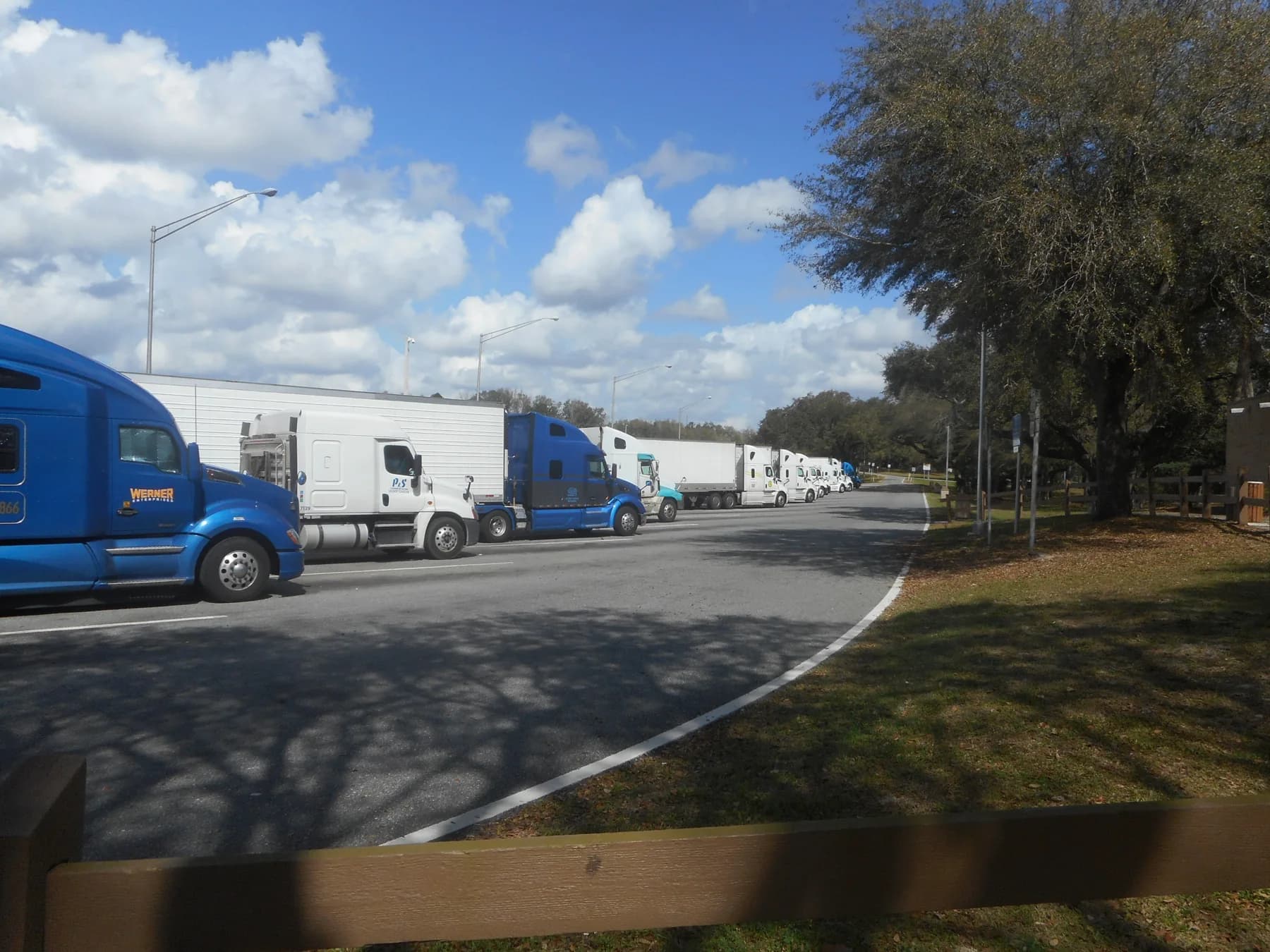

Heavy trucks use the Interstate system three ways at once: as the designated spine of a national freight network defined in federal law, as the specific road system on which federal gross and axle weight limits apply, and as an operating environment whose grades, ramps, merges and traffic speeds dictate how the vehicle has to be driven. Those are three separate things, and confusing them is the usual source of bad claims about truck traffic.
The Interstate is the core of a designated network
The Fixing America's Surface Transportation Act directed the Federal Highway Administration to establish a National Highway Freight Network, and FHWA describes it as four subsystems. The Primary Highway Freight System is the set of roadways identified as the most critical, and after the 2022 congressional re-designation it consists of about 41,799 centerline miles, of which 38,014 are Interstate and 3,785 are non-Interstate.
The remaining Interstate mileage is in the network too. FHWA puts the non-PHFS Interstate portion at an estimated 10,265 centerline miles, based on Interstate mileage reported in the National Highway System as of October 17, 2019, and notes the figure fluctuates as routes are added and removed. Two further subsystems are designated by states and metropolitan planning organizations: about 5,390 centerline miles of Critical Rural Freight Corridors and about 2,656 centerline miles of Critical Urban Freight Corridors, both as of January 2023. Together the network runs to about 60,110 centerline miles.
| Subsystem | Mileage FHWA reports | As of |
|---|---|---|
| Primary Highway Freight System | ~41,799 centerline miles | 2022 re-designation |
| Other Interstate not on the PHFS | ~10,265 centerline miles | NHS Interstate mileage, Oct 17, 2019 |
| Critical Rural Freight Corridors | ~5,390 centerline miles | January 2023 |
| Critical Urban Freight Corridors | ~2,656 centerline miles | January 2023 |
Designation is a funding and policy instrument, not a measurement. A road being on the PHFS says federal resources and performance attention are pointed at it. It does not say how many trucks used it yesterday.
Weight limits attach to this road system in particular
The federal weight ceilings are written for the Interstate. FHWA's bridge formula guidance states the Interstate limits as 20,000 pounds on a single axle, 34,000 pounds on a tandem, and 80,000 pounds gross, unless the Bridge Formula dictates a lower figure for a particular group of axles. Gross means the vehicle or combination and any load on it, so 80,000 pounds is not a payload allowance; the tractor and trailer are inside the number. How much a semi truck weighs unpacks what that leaves for freight.
Those limits are also not universal. FHWA notes that some states hold higher Interstate limits under grandfather rights preserved when the limits were adopted in 1956 and amended in 1975, and oversize or overweight movements run under separate permits. Truck weight, roads and bridges works through the formula and the exceptions.
Modeled flows are not observed traffic
The national freight maps FHWA publishes are the most common source of "how much truck traffic does this corridor carry" claims, and they need reading carefully. The Office of Freight Management and Operations publishes estimated average daily Freight Analysis Framework truck volumes on the National Highway System for a 2017 base year and for a 2050 projection, along with commodity-specific versions of both. A 2050 sheet is a forecast. A 2017 sheet is a modeled estimate tied to a year that is now well in the past. Neither is a live count, and FHWA separately points to the Highway Performance Monitoring System and the National Performance Management Research Data Set as the underlying data resources.
What the road asks of the driver
Interstate geometry sets the operating problem. Commercial driver training material frames following distance as at least one second for every 10 feet of vehicle length below 40 mph, with an extra second added above that, which puts a 60-foot combination at seven seconds at highway speed. Entering and crossing traffic needs a larger gap than a car would take, because acceleration varies with the load and a heavy vehicle occupies more road while it gets up to speed.
Grades change the calculation again. Speed on a downgrade has to suit the total weight of vehicle and cargo, the length and steepness of the grade, the road surface and the weather, and engine braking is the principal control rather than the service brakes. Work zones, a permanent feature of a mature Interstate system, come with their own instruction to hold the posted speed and slow further when workers are close to the travel lanes. The distance side of this is covered in truck stopping distance, and the state-level picture in Texas freight corridors.
Where to check the claims
Three questions separate a solid statement about Interstate truck use from a weak one. Is this a designation, a model output, or a count? What year does the number belong to? And does the limit being quoted apply to the Interstate, to a state highway, or to a permitted movement? The sources below answer all three, and each of them dates its own figures.
Sources
- FHWA: National Highway Freight Networkops.fhwa.dot.gov/freight/infrastructure/nfn/index.htmSource consulted: 2026-09-18. Regulations may change; check the current official text before relying on them.
- FHWA: Bridge Formula Weights (FHWA-HOP-19-028, August 2019)ops.fhwa.dot.gov/freight/publications/brdg_frm_wghts/index.htmSource consulted: 2026-09-18. Regulations may change; check the current official text before relying on them.
- FHWA: Freight National Statistics and Mapsops.fhwa.dot.gov/freight/freight_analysis/nat_freight_stats/index.htmSource consulted: 2026-09-18. Regulations may change; check the current official text before relying on them.
- New Jersey MVC Commercial Driver License Manualnj.gov/mvc/pdf/license/CDL_Manual.pdfSource consulted: 2026-09-18. Regulations may change; check the current official text before relying on them.
Read next
Truck Weight, Roads, and Bridges
Why federal law limits Interstate truck weight three ways at once, how the Bridge Formula turns axle spacing into a weight limit, and which exceptions change the answer.
Major Freight Corridors in Texas
A guide to the Interstate routes in FHWA’s Texas freight network, the state’s regional freight priorities, and what a network designation does—and does not—tell you.
How Much Does a Semi Truck Weigh?
The 80,000-pound figure is a federal Interstate limit on gross weight, not a typical weight and not a payload. What the limits actually cover, how axles and spacing constrain them, and where they do not apply.
How Far Does a Truck Need to Stop?
Stopping distance for an air-braked truck has four parts, not one, and weight does not affect it the way most people assume. What the CDL training figures say, and what they do not.