Mass, sight lines, braking and trailer geometry all change what happens in a collision, and they change what can be done about it beforehand. This section covers stopping distance, the areas around a tractor-trailer a driver cannot see, fatigue, and underride.
Reporting here follows published research and federal crash data. Where a number appears, the source it came from is listed at the foot of the piece.
Start with this
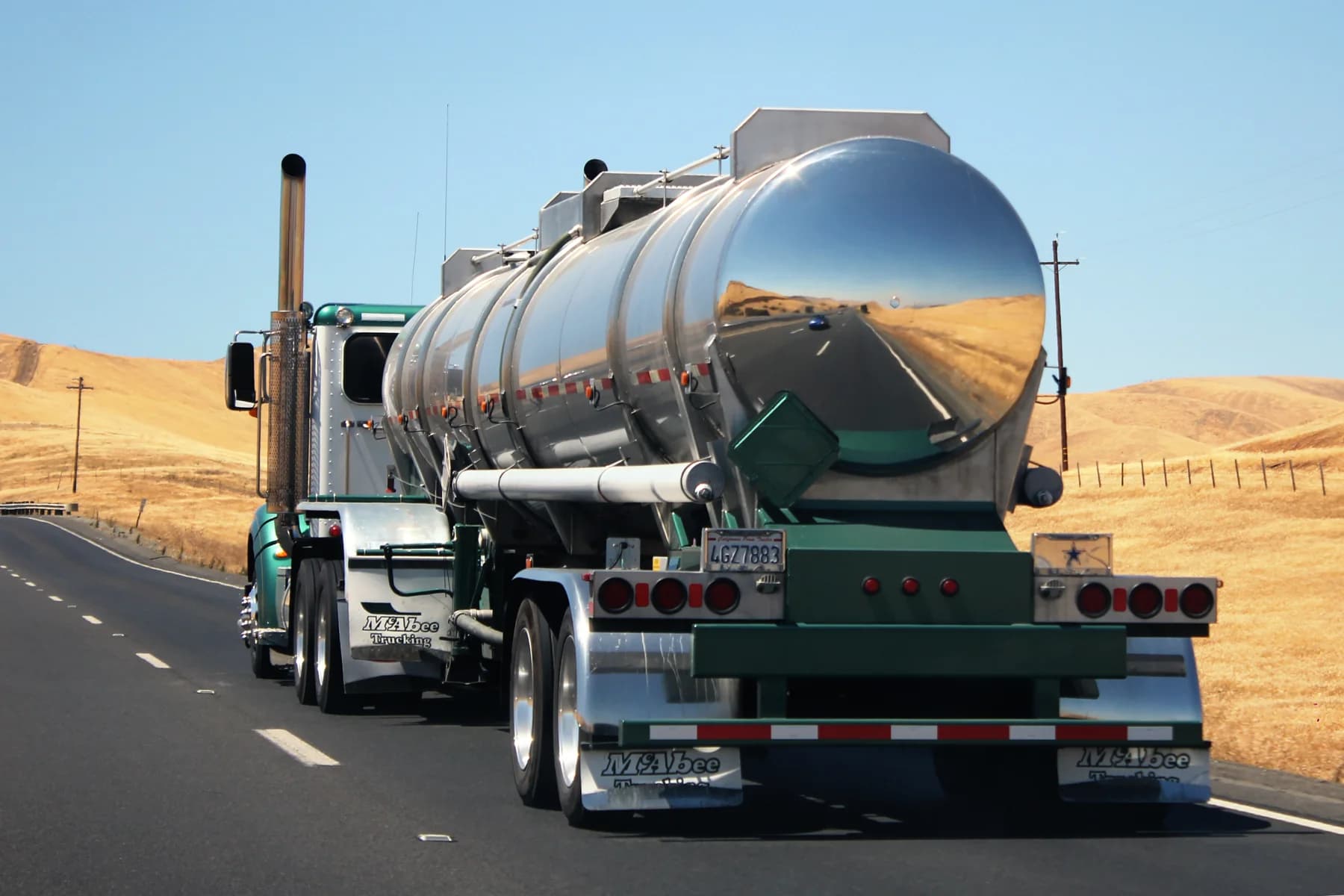
Tanker truck traveling on a divided highway. Photograph: Carlos ZGZ.CC0 via commons.wikimedia.org. Resized and converted to WebP; display may crop.
Stopping distance for an air-braked truck has four parts, not one, and weight does not affect it the way most people assume. What the CDL training figures say, and what they do not.
Reading order
Start with the general case, then the four specific failure modes.
What separates a crash involving a loaded combination vehicle from a car-to-car collision, read out of federal safety regulations and commercial driver training material.
Stopping distance for an air-braked truck has four parts, not one, and weight does not affect it the way most people assume. What the CDL training figures say, and what they do not.
Large trucks have areas their mirrors cannot show, and driver training treats that as a property of the vehicle rather than a lapse. What the CDL manual says about mirrors, backing, and turns — and what it declines to map.
Federal law regulates fatigue in two separate ways — hours-of-service limits and a standalone prohibition on driving while impaired by fatigue. What each says, what the exceptions are, and what the records show.
Underride happens when a smaller vehicle passes beneath the body of a larger one. What 49 CFR 393.86 requires of trailers and of other trucks, the exceptions it lists, and what it does not cover.
Federal law regulates fatigue in two separate ways — hours-of-service limits and a standalone prohibition on driving while impaired by fatigue. What each says, what the exceptions are, and what the records show.
Underride happens when a smaller vehicle passes beneath the body of a larger one. What 49 CFR 393.86 requires of trailers and of other trucks, the exceptions it lists, and what it does not cover.
Large trucks have areas their mirrors cannot show, and driver training treats that as a property of the vehicle rather than a lapse. What the CDL manual says about mirrors, backing, and turns — and what it declines to map.
What separates a crash involving a loaded combination vehicle from a car-to-car collision, read out of federal safety regulations and commercial driver training material.
.jpg)