Underride Crashes and the Rear Guard Rule
Underride happens when a smaller vehicle passes beneath the body of a larger one. What 49 CFR 393.86 requires of trailers and of other trucks, the exceptions it lists, and what it does not cover.
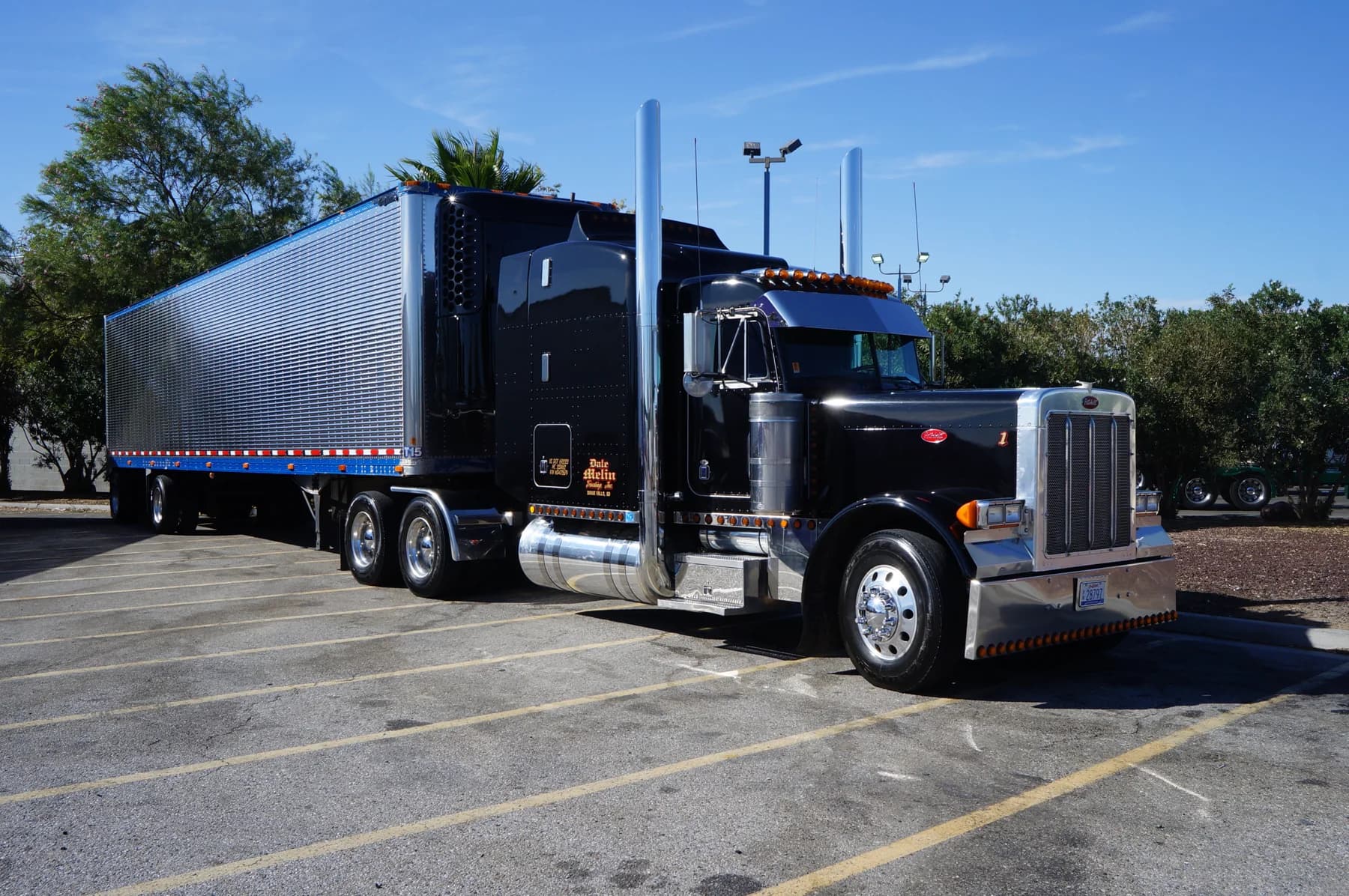
_Truck_Peterbilt_at_Flying_J_Travel_Plaza_(en2016)_(4).JPG)
Underride is the geometry problem created when a trailer's body sits higher off the ground than the hood of a car. If the car's structure passes beneath the trailer rather than meeting it, the vehicles may not engage at the same structural height. The cited equipment regulation does not quantify the crashworthiness outcome of any particular collision. The federal response is 49 CFR 393.86, which requires rear impact guards — the horizontal bar visible beneath the back of a trailer — and specifies where that bar must sit in inches and millimetres. The rule is a dimensional and equipment standard, and reading it closely shows both what it covers and how much it leaves outside its scope.
What the rule requires of trailers
Paragraph (a) sets the modern requirement. Each trailer and semitrailer with a gross vehicle weight rating of 4,536 kg (10,000 pounds) or more, manufactured on or after January 26, 1998, must be equipped with a rear impact guard meeting Federal Motor Vehicle Safety Standard No. 223 (49 CFR 571.223) in effect when the vehicle was manufactured. Installed on the vehicle, the guard must at minimum meet FMVSS No. 224 as in effect at manufacture.
The geometry is then pinned down:
| Dimension | Requirement |
|---|---|
| Width | Outermost surfaces within 100 mm (4 in) of the vehicle's side extremities, not beyond them |
| Height above ground | Not more than 560 mm (22 in) at any point across the full width |
| Distance from rear | At any height 560 mm (22 in) or more, rearmost surface within 305 mm (12 in) of the rear extremity |
| Cross-section | Horizontal member at least 100 mm (3.94 in) vertical height across the guard width |
Guards with rounded corners may curve upward, or forward, within 255 mm (10 in) of the relevant side plane.
The older rule for other trucks
Paragraph (b) is a separate, earlier regime for vehicles within its stated scope. It applies to motor vehicles manufactured after December 31, 1952 — other than trailers and semitrailers covered by paragraph (a), and excluding truck tractors, pole trailers, pulpwood trailers, road construction controlled horizontal discharge trailers, and vehicles in driveaway-towaway operations — where the vertical distance between the rear bottom edge of the body, or the chassis assembly if that is rearmost, and the ground is greater than 76.2 cm (30 inches) when the vehicle is empty.
That is a trigger, not a blanket. A straight truck whose body sits lower than 30 inches when empty is outside the requirement. Where it applies, the guard must keep its bottom no more than 30 inches above the ground when empty, sit no more than 61 cm (24 in) forward of the rear extremity, come within 45.7 cm (18 in) of each side extremity, and, if more than one guard is used, leave no more than 61 cm (24 in) between the closest points. Construction must be substantial, attached by bolts, welding, or comparable means. Low chassis vehicles, special purpose vehicles, and wheels back vehicles whose own structure gives comparable protection are treated as compliant.
The distinction between the two paragraphs maps onto the vehicle types described in semi, box truck, or straight truck: the trailer behind a tractor and the box body on a single frame are governed by different text, with different dimensions and different dates.
The exceptions are part of the rule
Paragraph (a) does not apply to pole trailers, pulpwood trailers, low chassis vehicles, special purpose vehicles, wheels back vehicles, road construction controlled horizontal discharge trailers, or trailers towed in driveaway-towaway operations. Any statement that "all trailers must have rear guards" is therefore too strong. So is any statement that the guard on a given vehicle must be new — the requirement is pegged to the standard in effect at the time of manufacture, which means the rear of a 1999 trailer and the rear of a recent one are not necessarily held to identical criteria.
Dates are worth noting for a different reason. The Cornell reproduction of this section carries a source note listing amendments at 64 FR 47708 (1999), 67 FR 61824 (2002), 86 FR 62111 (2021), and 91 FR 7877 (February 19, 2026). We have read the text as reproduced, not the rulemaking documents behind those amendments, and we are not characterizing what each one changed.
What this section does not cover
393.86 is titled "Rear impact guards and rear end protection," and that is its scope. Nothing in the text read here establishes a general federal requirement for side underride guards or front underride guards on trailers. Side impacts and front-end geometry are real subjects, but they are not governed by the paragraphs above, and this article is not going to assert a requirement it has not read.
We are also not publishing casualty counts for underride. Figures circulate widely, and the ones we have seen are not traceable to a dataset we have verified. Our editorial policy treats an untraceable statistic the same way whether or not it supports the point being made.
Where the guard sits in the wider picture
A guard is a last-resort structure, and a fixed one: it is a bar of specified height, width, and setback, not an adjustable safety system. Everything that determines the speed at which a vehicle reaches it happens earlier — the four-part stop described in truck stopping distance, the following-distance rule from commercial driver training of at least one second per 10 feet of vehicle length, plus a second above 40 mph, and the visibility limits set out in commercial truck blind spots. Driver training also notes the practical problem behind many of these encounters: in a large vehicle it is often hard to see whether a vehicle is close behind, and trucks are tailgated most when they are moving slowly or when visibility is bad.
The regulation defines a minimum piece of hardware at the back of a vehicle. It does not, on its own terms, promise an outcome in any particular crash.
Sources
- 49 CFR 393.86 — Rear impact guards and rear end protection (Cornell LII reproduction)law.cornell.edu/cfr/text/49/393.86Source consulted: 2026-09-18. Regulations may change; check the current official text before relying on them.
- New Jersey MVC Commercial Driver License Manualnj.gov/mvc/pdf/license/CDL_Manual.pdfSource consulted: 2026-09-18. Regulations may change; check the current official text before relying on them.
Read next
How Far Does a Truck Need to Stop?
Stopping distance for an air-braked truck has four parts, not one, and weight does not affect it the way most people assume. What the CDL training figures say, and what they do not.
Semi, Box Truck, or Straight Truck: What Actually Separates Them
A semi is a combination of two units, a straight truck is one frame, and a box truck describes a body style. The differences change handling, brakes, licensing, and which federal rules apply.
Where a Commercial Truck's Blind Spots Are
Large trucks have areas their mirrors cannot show, and driver training treats that as a property of the vehicle rather than a lapse. What the CDL manual says about mirrors, backing, and turns — and what it declines to map.