How Commercial Truck Braking Systems Work
How air-braked commercial vehicles use compressors, tanks, foundation brakes and spring brakes. Other commercial vehicles may use hydraulic systems.
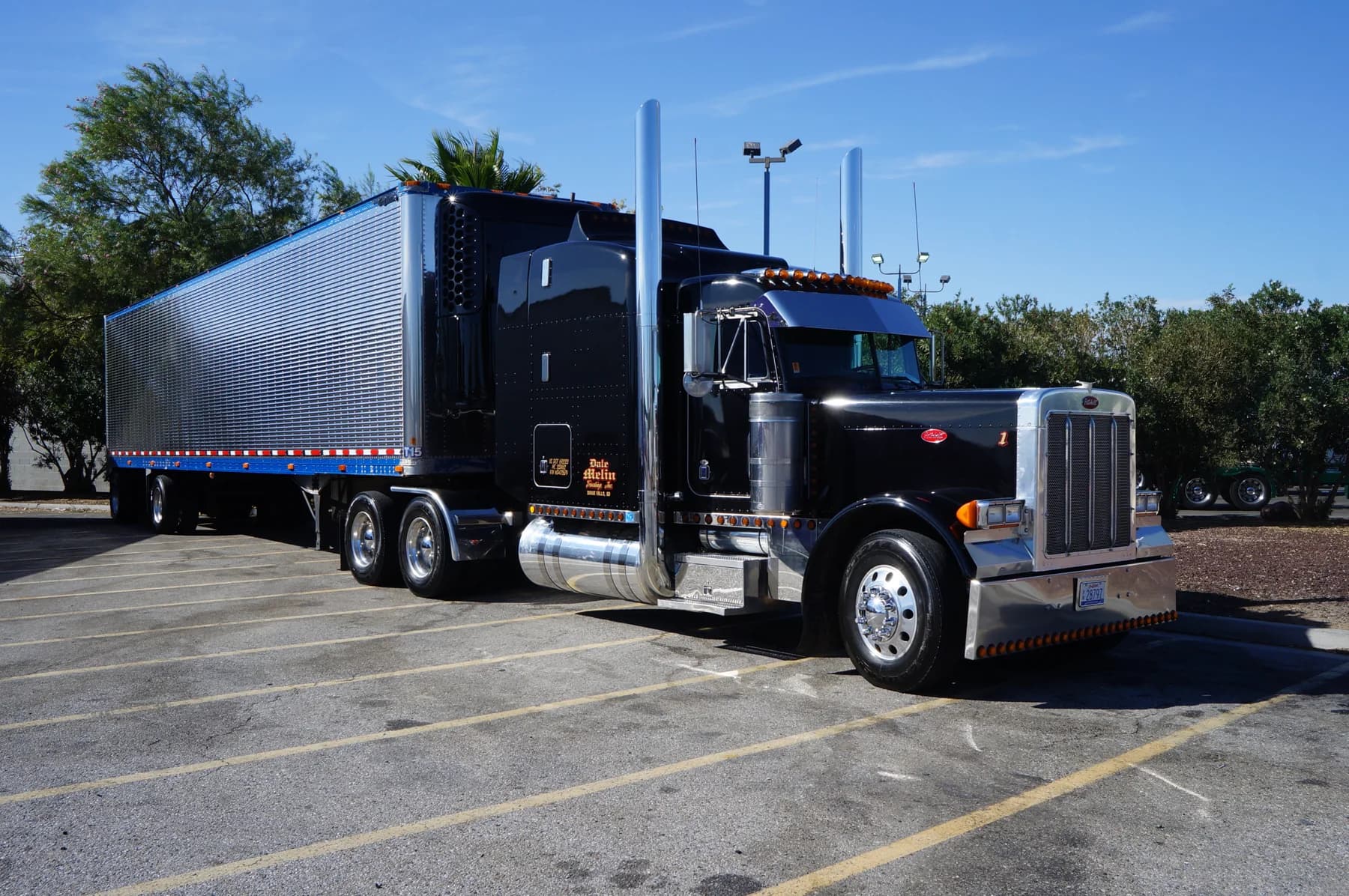
_Truck_Peterbilt_at_Flying_J_Travel_Plaza_(en2016)_(4).JPG)
On an air-braked truck, compressed air operates the brakes, and what looks like one system has three functions. Not every commercial truck uses air brakes; hydraulic systems are also used. The New Jersey commercial driver license manual describes the service, parking and emergency systems: the service system applies and releases the brakes from the pedal during normal driving, the parking system works from a cab control, and the emergency system borrows parts from both to stop the vehicle if the brake system fails. This article explains air-brake principles, not vehicle-specific inspection or repair procedures.
Why air instead of fluid
The manual pairs hydraulic brakes with cars and light and medium trucks, and air with large and heavy vehicles, calling air "a good and safe way of stopping large and heavy vehicles, but the brakes must be well maintained and used properly." Air can be generated continuously by the engine, stored, piped the length of a combination, and — critically — used as a hold-off force, which is what makes the fail-applied parking brake described below possible. The mass involved is not trivial: on the Interstate System, FHWA's guidance puts the federal gross weight ceiling at 80,000 pounds, so the braking system across the vehicle or combination must manage substantial energy. Vehicle-specific ratings, exceptions and axle limits still apply.
The supply side
An engine-driven air compressor pumps air into storage tanks. A governor decides when: at a cut-out pressure of around 125 psi it stops the compressor pumping, and at a cut-in pressure of around 100 psi it starts it again. The tanks hold enough air to allow the brakes to be used several times even if the compressor stops working. A safety relief valve in the first tank, usually set to open at 150 psi, protects the system from overpressure — and if it releases, the manual's instruction is that something is wrong and a mechanic should fix it.
Compressed air carries water and compressor oil, which collect at the bottom of the tanks and which the manual is emphatic about draining, because water can freeze in cold weather and cause brake failure. Some systems add an alcohol evaporator to reduce the risk of ice in valves. This is the unglamorous part of the system and the part most exposed to deferred maintenance.
Foundation brakes at the wheel
At each wheel sits the foundation brake. The most common type is the s-cam drum brake: pedal pressure admits air to a brake chamber, the chamber rod pushes the slack adjuster, the camshaft turns the S-shaped cam, and the cam forces the brake shoes against the inside of the drum. Friction slows the vehicle and produces heat. Wedge brakes drive a wedge directly between the shoe ends; air disc brakes use a power screw to clamp a rotor between pads in a caliper. The manual notes both are less common than s-cam.
Spring brakes, and failure that applies the brakes
Parking and emergency brakes must be held on by mechanical force, because air pressure can eventually leak away. Spring brakes meet that need by inverting the logic: powerful springs are held back by air pressure while driving, and removing the air lets the springs apply the brakes. A leak severe enough to lose all air will therefore set the brakes. On tractors and straight trucks, the manual says spring brakes come fully on when pressure drops into a range of 20 to 45 psi, typically 20 to 30 psi — and it warns drivers not to wait for that, because a heavily loaded vehicle will take a long distance to stop when the spring brakes do it, since they do not work on all axles, and a lightly loaded vehicle may skid out of control.
Redundancy and warnings
Most heavy-duty vehicles use dual air brake systems: two separate systems with their own tanks and lines, sharing one set of controls, one primary and one secondary. The manual's pre-drive instruction is to build a minimum of 100 psi in both before moving. A visible low-pressure warning is required before tank pressure falls below 55 psi, often a red light, sometimes a buzzer, and on older vehicles a mechanical "wig wag" arm that drops into view. If one system is very low, either the front or rear brakes will not be operating fully — and it will take longer to stop.
Heat, adjustment, and the limits of ABS
Brake fade is the failure mode the manual spends most words on. Excessive use of the service brakes overheats the linings, which changes them chemically and reduces friction, while the drums expand so the shoes must travel farther and contact with less force. Adjustment compounds it: brakes out of adjustment stop doing their share, the remaining brakes overheat and fade, and the manual observes that brakes can go out of adjustment quickly, especially when hot. On a long downgrade the brakes are described as a supplement to the engine's braking effect, not the primary means of speed control.
Antilock brakes address a different problem. ABS prevents wheel lockup and preserves steering and stability, and the manual is careful about the claim: "You may or may not be able to stop faster with ABS, but you should be able to steer around an obstacle while braking." It is a control technology, not a shortcut past the physics described in truck stopping distance.
What a combination adds
Pulling a trailer adds plumbing. An air-braked combination uses two connecting air lines — a blue-coded service line carrying the pressure the pedal commands to relay valves, and a red-coded emergency or supply line that both charges the trailer tanks and triggers the trailer emergency brakes when it loses pressure. They join at glad-hand couplers, and a tractor protection valve closes automatically in the 20-to-45 psi range to stop air escaping from the tractor. Cross the lines and the trailer spring brakes will not release; on older trailers without spring brakes, the manual warns, you could drive away with no trailer brakes at all. That hardware difference is one of the practical separations between a semi and a straight truck, and the weight the system has to control is the other half of the problem.
Sources
- New Jersey MVC Commercial Driver License Manualnj.gov/mvc/pdf/license/CDL_Manual.pdfSource consulted: 2026-09-18. Regulations may change; check the current official text before relying on them.
- FHWA Bridge Formula Weightsops.fhwa.dot.gov/freight/publications/brdg_frm_wghts/index.htmSource consulted: 2026-09-18. Regulations may change; check the current official text before relying on them.
Read next
How Far Does a Truck Need to Stop?
Stopping distance for an air-braked truck has four parts, not one, and weight does not affect it the way most people assume. What the CDL training figures say, and what they do not.
Semi, Box Truck, or Straight Truck: What Actually Separates Them
A semi is a combination of two units, a straight truck is one frame, and a box truck describes a body style. The differences change handling, brakes, licensing, and which federal rules apply.
How Much Does a Semi Truck Weigh?
The 80,000-pound figure is a federal Interstate limit on gross weight, not a typical weight and not a payload. What the limits actually cover, how axles and spacing constrain them, and where they do not apply.