Where a Commercial Truck's Blind Spots Are
Large trucks have areas their mirrors cannot show, and driver training treats that as a property of the vehicle rather than a lapse. What the CDL manual says about mirrors, backing, and turns — and what it declines to map.
.jpg)
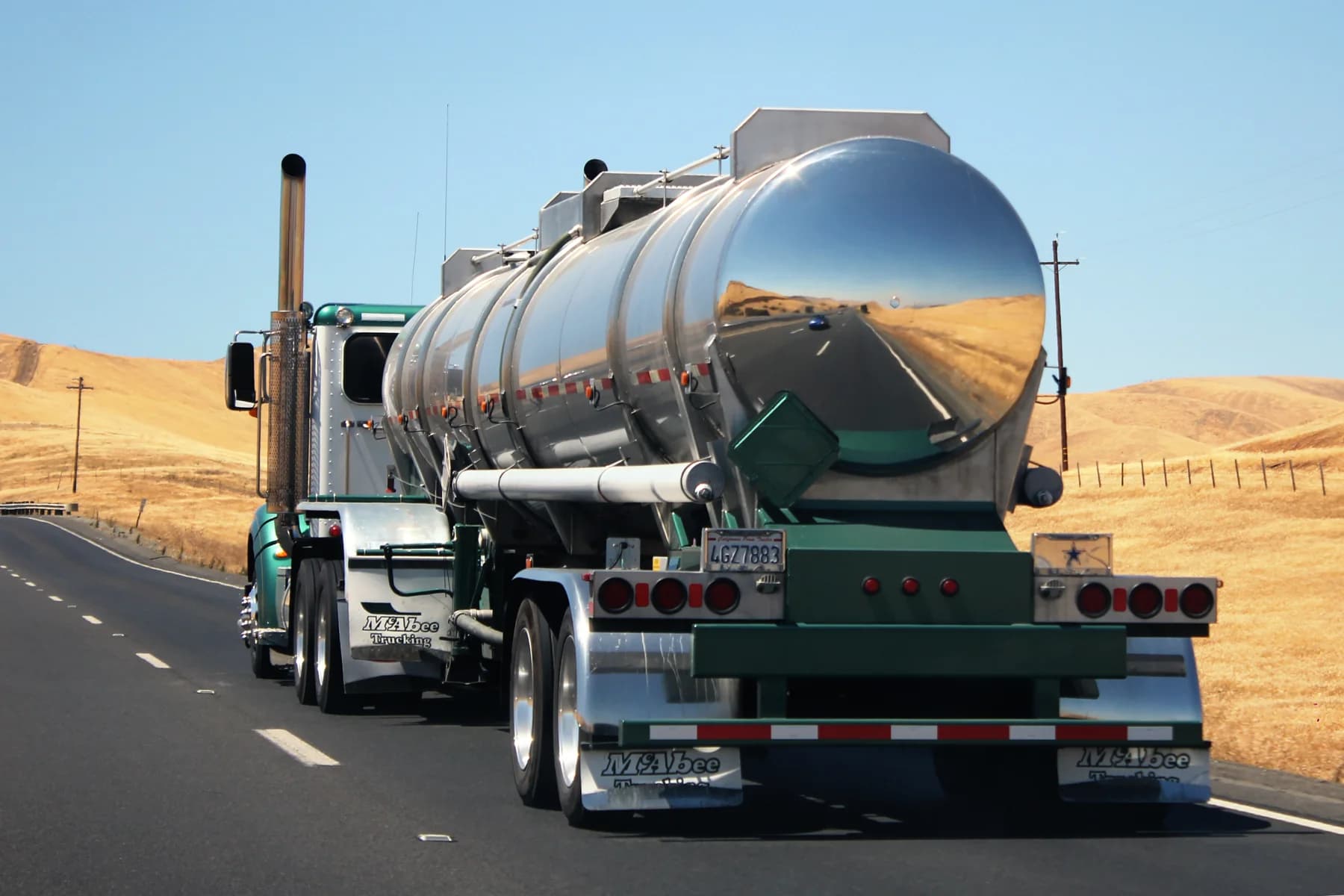
A commercial truck has areas around it that no mirror shows, and commercial driver training treats this as a fixed property of a large vehicle rather than a failure of attention. The New Jersey commercial driver license manual states it directly: "There are 'blind spots' that your mirrors cannot show you," and its instruction is to check mirrors regularly not only to see where other vehicles are, but "to see if they move into your blind spots." The manual builds its whole seeing-and-space method around that limitation — frequent scanning, wide margins, and refusing to rely on a single glance.
What a blind spot is on a vehicle this size
Passenger cars also have blind spots; mirrors and shoulder checks do not guarantee that every nearby road user is visible. On a tractor-trailer, a large part of the vehicle is behind the driver and cannot be seen through glass at all. The manual's remedies are procedural rather than optical. Mirror adjustment is to be checked before every trip, and — a detail that matters for combinations — can only be checked accurately when the trailers are straight. Each mirror should be set to show some part of the vehicle, so the driver has a reference point for judging where everything else is.
Mirrors are also for watching the truck itself: tires, which the manual notes is one way to spot a tire fire, and open cargo, checked for loose straps, ropes, chains, or a flapping tarp.
Mirrors help, and they also mislead
Many large vehicles carry convex mirrors — the manual lists them as "fisheye," "spot," or "bug-eye" — which show a wider area than flat glass. The tradeoff is built into the optics: "everything appears smaller in a convex mirror than it would if you were looking at it directly. Things also seem farther away than they really are." A vehicle in that mirror is closer than it appears, and the manual's instruction is to know this and allow for it.
There is a second trap in using mirrors at all. The manual tells drivers to check quickly and look back and forth between mirrors and the road ahead, because focusing on a mirror too long means traveling a real distance without knowing what is happening in front — distance that, as our piece on stopping distance sets out, is already committed before the brakes do anything.
Situations that need more than a routine check
The manual singles out lane changes, turns, merges, and tight maneuvers as requiring more than regular mirror checks. For a lane change it prescribes a sequence rather than a glance: check before changing lanes to confirm there is room, check again after signaling to see that no one has moved into the blind spot, check right after starting the change, and check again after completing it. In turns, mirrors are used to confirm the rear of the vehicle will not hit anything. When merging, they are used to judge whether the gap is genuinely large enough.
The area behind is the one nobody can check
Backing is where the manual stops pretending mirrors are sufficient. It tells drivers to get out of the vehicle and check the path when unsure, to back as slowly as possible in the lowest reverse gear, and to back and turn toward the driver's side — because "backing toward the right side is very dangerous because you can't see as well" — even if that means driving around the block to set up the approach. And it says plainly to use a helper: "There are blind spots you can't see. That's why a helper is important," positioned near the back of the vehicle where the driver can see them, with hand signals agreed in advance including a signal for stop.
Overhead and underneath are the forgotten ones. Before backing into an area, the manual says to get out and check for overhanging branches, wires, and similar objects, because they are easy to miss while reversing.
Turns create a moving hazard zone
Off-tracking means the rear wheels follow a tighter path than the front ones through a corner, and longer vehicles off-track more, with a trailer's rear wheels tracking inside the tractor's. The manual's right-turn rules exist because of it: turn slowly; if the turn cannot be made without swinging into another lane, turn wide as you complete the turn while keeping the rear of the vehicle close to the curb — specifically so other drivers cannot pass on the right. Swinging wide to the left first is discouraged for exactly that reason: a following driver may read it as a left turn and try to pass on the right, into the space the truck is about to occupy. On left turns, the manual says to reach the center of the intersection before starting the turn, because turning too soon puts the vehicle's left side into other traffic through off-tracking.
Alongside is a related problem. The manual advises against traveling next to other vehicles at all, for two reasons: another driver may change lanes into you, and you may be trapped when you need to change lanes yourself.
What this article will not give you
You will not find a diagram here with lane counts and distances for each blind zone. The driver training material cited above describes blind spots as real and consequential without publishing a general map of them for tractor-trailers, and the geometry genuinely varies with cab design, mirror fitment, trailer length, and articulation angle. Inventing a tidy four-zone picture would be more satisfying than the source supports.
What the source does support is the behavior the picture is usually drawn to justify: do not sit alongside a large vehicle, do not linger directly behind it, expect the rear of it to swing through space the cab has already left, and do not assume that the truck driver has seen you. Your view of a mirror is not a reliable test of what the driver has noticed. The same reasoning underlies the rear-end geometry discussed in underride crashes, and the handling differences in semis, box trucks, and straight trucks.
Sources
- New Jersey MVC Commercial Driver License Manualnj.gov/mvc/pdf/license/CDL_Manual.pdfSource consulted: 2026-09-18. Regulations may change; check the current official text before relying on them.
Read next
How Far Does a Truck Need to Stop?
Stopping distance for an air-braked truck has four parts, not one, and weight does not affect it the way most people assume. What the CDL training figures say, and what they do not.
Semi, Box Truck, or Straight Truck: What Actually Separates Them
A semi is a combination of two units, a straight truck is one frame, and a box truck describes a body style. The differences change handling, brakes, licensing, and which federal rules apply.
Underride Crashes and the Rear Guard Rule
Underride happens when a smaller vehicle passes beneath the body of a larger one. What 49 CFR 393.86 requires of trailers and of other trucks, the exceptions it lists, and what it does not cover.